
Out of Service (OOS) violation for a truck in a fleet is costly. When it is for something preventable, it hurts even more: missed deliveries, frustrated customers, idle drivers, and unexpected costs. And while brakes and lights get the most attention, the real surprise is this:
Tires are the #1 cause of Out-of-Service violations in the U.S.
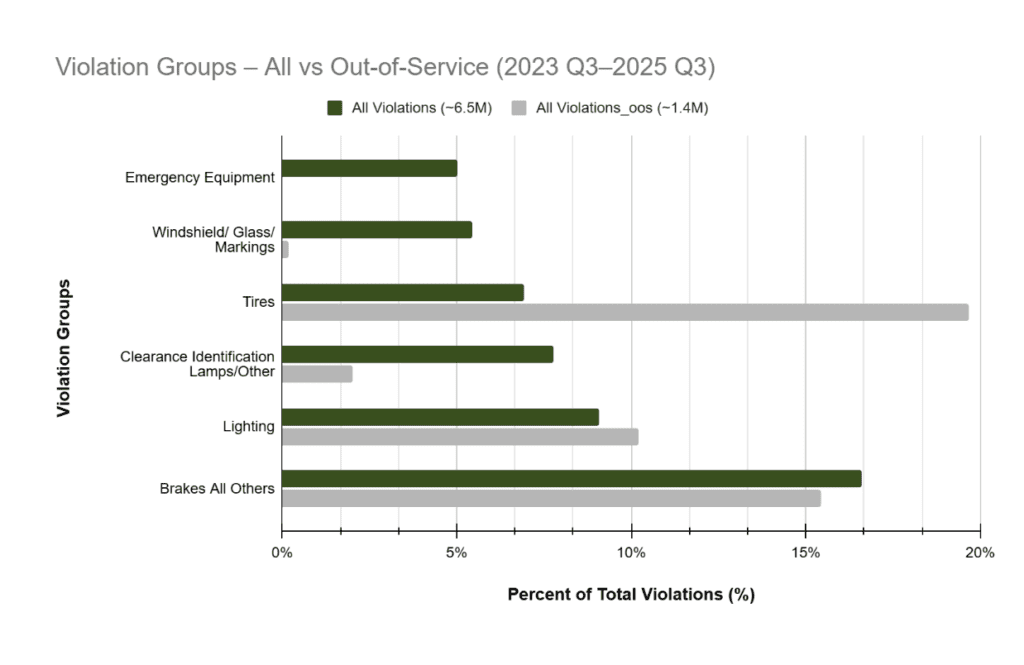
From Q3 2023 to Q3 2025, inspectors logged about 6.5 million violations across commercial motor carrier fleets (trucking and motorcoach vehicles). Of these, tire-related issues ranked 4th overall, roughly 7% of all cases.
But the real eye-opener is that tire issues account for 20% of the 1.4 million Out Of Service (OOS) violations. And 9 out of 10 of these tire issues are low tire pressure or leaks.
In other words: Tires don’t get flagged often, but when they do, the truck stops moving. Inflation is the top compliance and uptime risk.
A clear path forward lies in adopting continuous tire monitoring, intelligent analytics, and proactive tread management. Together these reduce violations, enhance safety, and extend tire life. Let’s look at the result of our analysis based on the FMCSA SMS Input – Violation dataset.
Where Tire Violations Come From (And Why They’re Preventable)
1. Underinflation Dominates
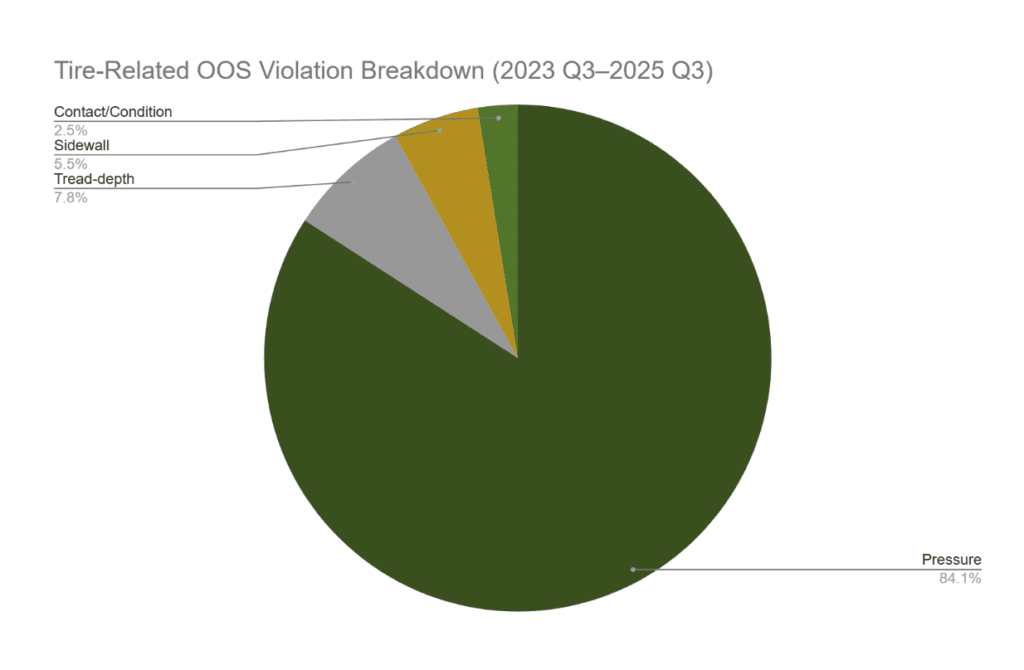
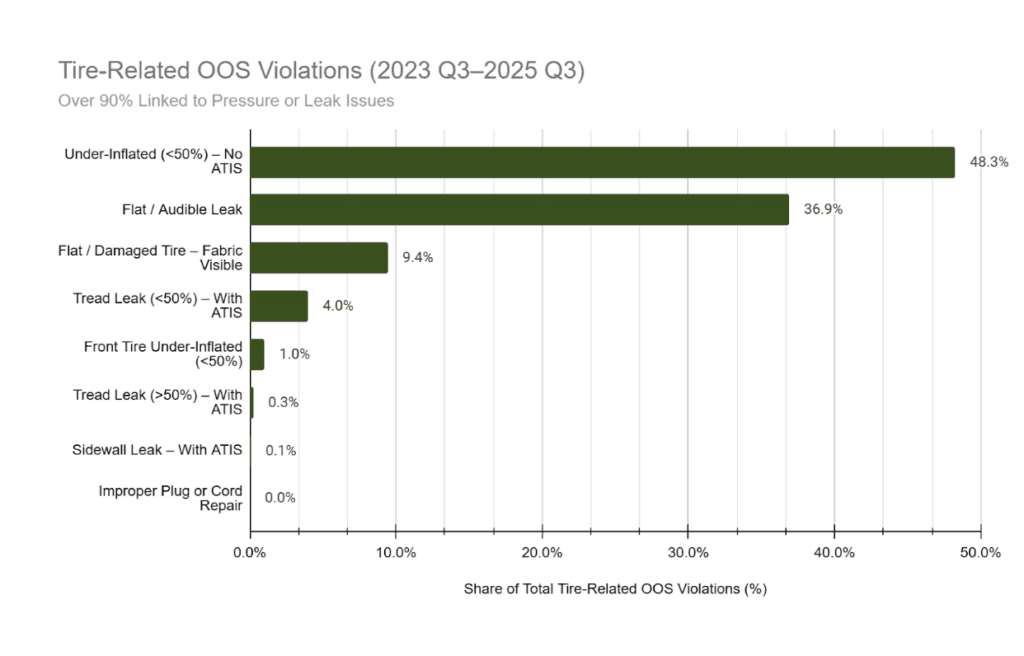
Among all tire-related OOS violations, one issue stands out: 84% of OOS tire violations are from low or leaking pressure. These preventable failures typically stem from inconsistent pre-trip inspections and the absence of real-time pressure monitoring. Most of these boil down to three recurring problems:
| Issue | % of Pressure OSS Cases | What it May Look Like on the Road |
|---|---|---|
| Tire at ≤50% of the proper inflation | ~48% | Driver notices the truck “dragging” |
| Audible air leak / clear flat | ~37% | Inspector hears it before you even get out |
| Fabric or cords showing | ~9% | Tire is already overheated & breaking down |
Translation: Slow leaks start small… become under-inflation… become heat… become breakdowns. And most of this can’t be caught by a quick walkaround or visual-only inspections.
2. Tread Depth is Next And It’s Just as Costly
Tread violations happen when:
- Steer tires fall below 4/32”
- Drive or trailer tires fall below 2/32”
Even if the truck “felt fine,” inspectors don’t negotiate on tread. And once you’re OOS, you’re OOS.
Plus: shallow tread increases blowout risk, especially in wet conditions.
3. Sidewall Damage = The Late Warning Sign
Bulges, cuts, or exposed ply material show up after the tire has been run under-inflated or overheated for a while. By the time you can see the damage, the tire is near the end. This is why fleets who “fix problems when they show up” wind up replacing tires early and paying for avoidable roadside calls. By contrast, connected monitoring systems can detect defects much earlier, preventing roadside failures.
The Real Cost: Downtime + Fuel + Tire Life
Low tire pressure triggers violations and also:
- Burns more fuel (higher rolling resistance)
- Overheats rubber (accelerates wear)
- Causes casing damage (kills retread value)
- Shortens tire life by 15–25% on average
Every OOS order translates into unplanned downtime, service disruption, and lost productivity. Persistent under-inflation also increases rolling resistance and heat buildup, accelerating tread wear and driving up fuel and maintenance costs. So the financial hit comes from more than the OOS, comes from miles before the violation.
The Shift: From Chasing Problems to Preventing Them
- Continuous Tire Intelligence = Fewer Surprises. This is where platforms like Revvo come in. Revvo tells you when a tire is low and we detect pressure loss trends (the early warning signs) so you can fix the leak before the tire gets damaged.
This directly addresses the 84% of OOS tire issues tied to pressure.
Even fleets running ATIS still recorded OOS events, about 4% of pressure violations.Why? Because ATIS refills air, but it doesn’t fix leaks. Revvo identifies the leak source and rate so you can prevent repeat issues.
- Real-Time Tread Wear Tracking. No surprises. No showing up at the scale house hoping tread depth is still compliant. Revvo maps tread wear over time and alerts you before hitting threshold.
- Audit-Ready Data When violations or roadside questions come up, every tire has:
- Health history
- Inspection timelines
- Maintenance action trail
Compliance becomes defensible instead of guesswork.
Tire Violations: Before vs After Monitoring
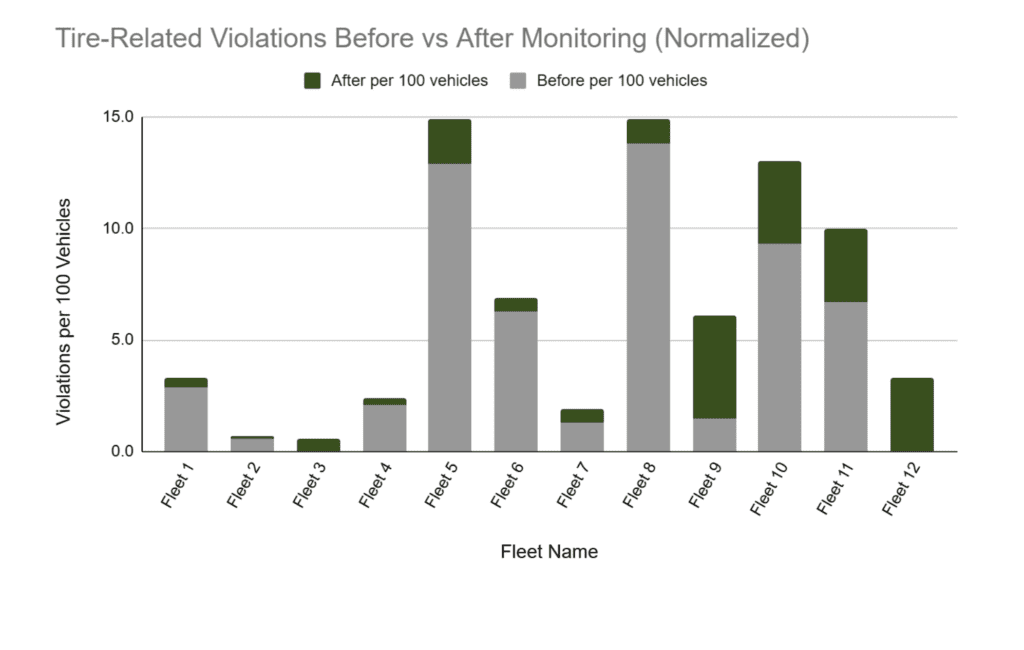
- An evaluation of tire-related violations across 12 fleets shows a marked improvement after implementing Revvo’s monitoring system. Normalized violation rates (per 100 vehicles) drop sharply across nearly every fleet, even though the post-monitoring window covers only four months.
- The largest fleet (Fleet 1) records an impressive 87% reduction, demonstrating that the impact scales effectively across high-volume operations. Fleets with historically high violation density (Fleets 5, 8, 10) show the strongest turnaround, achieving ~80% decreases and bringing their rates down to low single digits per 100 vehicles.
- The slight increase in violations on some fleets after monitoring is driven by small fleet sizes and improved visibility. Revvo reveals issues that previously went undetected.
- Overall, the data indicates that Revvo’s continuous tire monitoring meaningfully reduces violation exposure, improves compliance, and delivers measurable operational value in a very short timeframe.
The Bottom Line for Fleets
| Without Tire Intelligence | With Revvo Tire Intelligence |
| Reactive repairs | Preventive leak & pressure fixes |
| Surprise OOS violations | Advance alerts before thresholds |
| Higher fuel + tire spend | Lower rolling resistance + longer tire life |
| Unplanned downtime | Controlled maintenance scheduling |
Fewer breakdowns.
Longer tire life.
Better compliance.
Lower fuel cost.
And most importantly: Drivers keep moving, loads keep moving, and business keeps moving.